Thursday, September 19, 2013

Kiln Diary #2- Bisque load

     Having to restock the mug population takes a long time.  First I have to throw, trim and handle all the different styles.  Then I have to paint them.  I usually try to conquer only 2-3 different designs a day with about 10-15 mugs to show for it.   While I'm adding to the mug collection, I'll branch out onto a larger bowl or platter once my wrist becomes accustomed to the lines and I've tuned my eyes into the space the creature inhabits.  Sometimes a creature will get away with me, like the hummingbird, and I'll spend two days doing varieties of poses and dishware (they were battling ferociously at the feeder outside my studio window after all). The bluebirds too usually catch me in their sway, what with their extra painting required (lest I get too speedy in my production line!).
    This week I'm working on the second shelf of mugs, filling the kiln as I create them and stacking the accompanying platters and bowls that are accumulating on the studio shelves.  The mugs pack so densely in the kiln, it always takes longer than I expect to fill it!  I choose larger accompanying platters so that the rest of the kiln will more rapidly become sufficiently occupied.  But I have to complete the mug shelves first.
    Talking to my sister on the phone while painting a series of apple trees, I started to draw a pair of bluebirds dangling a robot from its arms.  Before getting too detailed, I carved the robot off though, figuring I'd spend so much time on the bluebirds, the robot would just make a waste of it.
     Then I told Kate what I was doing.
     "Ooh yeah" she said, "and have one of them poking his eyes out!" and with even more glee, "and the other one can be jamming his foot in its ear!"
     So as our conversation shifted to drones and whether or how soon they will be used domestically, her husband, her kids, Louie and Breaking Bad, I started on a new platter.
      I finished the coloring after I got off the phone.

Here is the battle, still dusty and before bisquing.  Picture taken with my dusty phone on my work chair.  The colors will darken and contrast further after the glaze firing.
   I think the robot lost.


ADDENDUM: -  The final product:

Tuesday, September 3, 2013

Kiln Diary

I've been taking photos of the kiln load as I unpack it and posting it on facebook, but the images get lost among the rest of the facebook flurry.  So I've decided to log the photos here, so I can write commentary and keep track of developments...

Here's the latest load, most of which sold at Kings Mountain this past weekend or was part of Sara & Jerry's wedding registry.


And here's the load before that (minus a shelf-full of mugs which doesn't really look that exciting from above):


This cone, set in place when loading the kiln for firing,
holds up a switch for the kiln
It gives you a sense of the volume of the kiln.

   To fire one glaze load, I turn the kiln on Low for 3.5 hours, Medium for 1 hour, then it takes another 10 for the kiln to get hot enough at High to melt the kiln sitter cone and turn it off.  Then I have to leave it alone for 15 hours, minimum, and slowly cool it after that so I can unpack and start again.  Most people seem to have computer controlled kilns these days, but there's something extremely attractive and natural about the melting of the kiln sitter cone, controlling when the correct temperature has been reached.   Very easy to fix too, unlike the computer.  Same with the electric elements.  If the firings start to take too long, I can test the voltage to find a break and fairly simply replace them.
      Bisque fires, the kiln firing before the pots get glazed, take just as long to warm up but are on High for only about 6 hours, depending on how much moisture is in the air and the clay.  As always, chaos reigns supreme.

When the kiln gets to the desired temperature,
the cone melts and the switch drops,
turning off the kiln,

Saturday, July 27, 2013

Buddha Bees

Buddha Knob
Before
This lovely Saturday morning, we got up at 5 AM to rescue bees.  Apparently we've given up being night owls by any stretch and instead find our thrills in that golden dawning light trying to beat the bees to consciousness.  With Joey's newly installed Buddha gear shift, we drove the hour and a half to the retreat, Odiyan, which looks like a mandala from a satellite perspective but is surrounded by tall fences and razor wire on the ground.  The bees found a perfect location in a wooden hose box in the garden.  Someone lifted the lid recently and caused their comb to collapse on itself, but the bees persevered regardless.  They were grumpy to be disturbed again, but we removed their comb into our frames and guided the bees back into our box with smoke and without too many stings (except through the veil!).
After- All the comb is inside our box even if all the bees aren't.. yet
  We decided to leave them there for the week to give them time to repair the comb and move into our box completely.  On the way to the bathroom, we passed a pond where I found my newest inspiration, the coot: well named and even better footed.  I never before noticed the odd lumps so different from a duck's webbing.  This may be another creature I end up decorating my own house with because I find them more fascinating than apparently anyone else does (like the dragon wrasse, the juvenile drum fish, the unicorn fish....) but I will persevere with yet another form of reckless abandon and paint coots!  Hope someone else out there loves them too!


 My new subject matter (conveniently in black and white) : The Coot.  You have to love those crazy feet!

Monday, July 8, 2013

Sometimes it's best to walk away...

     For the past few years we have been working with an apartment complex that always attracts bees.  This year they took us up on the suggestion of leaving bait hives on the roof of the building, near where we extracted bees previously.  Early in the spring, with clockwork simplicity, we collected two swarms in them.
This swarm is approx 4' wide
      Then our bee-enthusiast contact, John, called me about a "gigantic" swarm hanging on a tree at the entrance. Piggybacking on his enthusiasm, and needing a break from painting, I asked my neighbor Steve if he was up for an adventure.  He grabbed his camera and we crossed town to what we assumed would be an easy job.
First attempt
     John said he had a ladder set up and caution taped up the space.  It was a 3-legged, 15 foot orchard ladder and the hive was still 8 feet above it.  First I tried to attach the box to the top of the ladder and pull the branch down so I could shake the bees in it.  But I had no maneuverability and the branch wouldn't move.
     So we put the box on a white sheet on the ground (to help the crawling bees not get lost in other debris) and we rigged up a scoop at the end of a paint roller extension and we began whittling down the swarm, two cups at a time.  And it was a big swarm, possibly double-queened.  I would fill the scoop and pass the apparatus down to John's assistant and she emptied it on the sheet in front of the entrance to the bee box.  Luckily, on the second or third scoop, I apparently grabbed the queen because they began that adorable marching behavior, identical orientation and military-neat formation.  Each subsequent scoop followed suit.
The mesmerizing behavior when they know where their queen is
   
And that's the addicting part that keeps me going up ladders I shouldn't, over a skull-smashing pavement that should have deterred me, in swooning heat and falling perturbed bees who only naturally stung whatever was still exposed (my wrists).  The excitement and enthusiasm of a teeming group of people, in addition to the bees,  distracted us from the real danger I was putting myself in.  It's another version of what Joey calls my "reckless abandon" which usually refers to wild leaps while snowboarding on powdery soft days.  I was lucky this time
     We captured about 2/3 of the hive, but the rest stubbornly clung to the branch far out of reach no matter how much I shook it with an extension trimmer/saw or practically barbequed them with smoke in a can on that handy painter's extension pole.
Trying to smoke them off the branch
    After two hours, we went home with the majority, only fully grasping, as we were putting away our refuse, that I really should have done just that: Refuse to go up that ladder.  I'll admit it was fun and I have since verified that we got a queen and they are perfectly happy in our apiary.  BUT, I really should have taken my own safety into account.  There's a reason Joey is so hesitant about taking on a new bee job.
     Somebody has to.
     Who knows, maybe they would have moved into one of our bait boxes if we'd given them a few more hours, or at least moved on somewhere else like the ones I left behind did......

Follow up: The ones I left behind moved into the building and were very harassed and uncooperative about staying in our box on removal.  no easy solutions.


Tuesday, May 14, 2013

Prolific Bees!


New hive
Original Hive
When Joey went to investigate this bee job in Camp Meeker, there was a large hive going in between the frayed corner shingles on a second story deck.  Less than a week later, we came back to remove the hive and discovered dead bees sprinkling the deck.  On inspection, they were all drones.  The bees had swarmed into a new spot just five feet away and the dead drones were evidence of a young queen's mating flight.  Laying down our tarps, we opened up the new hive.  They were gentle and cooperative.  But the large hive.... we almost didn't do it.  This building is old and vacuous.  We were worried that the hive took up the entire north wall, which would require scaffolding on the outside of the building to access rather than our convenient deck location.  After a full day of collecting a full bait hive in the morning, working construction all day, then facing two hives instead of one, Joey was full of curses.   


Under the shingles, the bees peek
 out between the boards
Just 5 days of work!

Small Hive in new Home


     I took his hand,""This is our quality time, remember?  You love this."  Squeeze.
     "...and we don't have to do this right now if you're too tired."
  But we crossed our fingers and dug in.  Luckily, there was a bottom to their space and we were able to pull out all the comb.  There were multiple queen cells along several panels, indicating that they had more intentions of swarming.  As the sun faded, we left our two boxes in position for the bees to move in.

Original Hive exposed

Big box for plentiful bees
 But when Joey checked on them the next day, the large box was not fully cooperating.  Using cardboard and large yogurt containers, he scooped them into the box and commanded them to move in.
    Early next morning, returning to remove the hives, we discovered the problem.  Though the space they occupied was limited vertically, the bees had expanded horizontally under the floor of the deck.  As the majority of the bees were already in our box, we did a quick removal of this comb and population before the sun woke both boxes into further activity.  We left a bait hive behind for stragglers and took the rest home to our apiary.
Cleaned of bee debris, the space
is painted to mask any attractive
bee scent
    With the bees removed, Joey was able to repair our damage.
Joey fixed the frayed corner problem
Insulation fills the gaps to prevent
future invasion

 The bees are home now, bustling, and we're happy to wait a while for the next call of distress....


Thursday, April 18, 2013

Octo Recharge!

Day Octopus
 (no, I don't have an underwater camera so this is someone else's memory
...but I can relate
 Spent the last week under water in Maui getting re-inspired for before my first show of the year!  Fondled octopuses, ogled turtles, swam with unicornfish, fell in love with the blue boxfish, sharks and even a barracuda!  I've got all kinds of new designs competing for attention now!
The Turtles are coming too!

Unicornfish of course!
Spotted Blue Boxfish
Surprisingly, there was an Empty Bowls event taking place at Star Noodle in Lahaina.  I donated one year to an Empty Bowls event in Sacramento so I was curious what actually happened.  Potters provide handmade bowls which patrons buy and fill with the sponsoring
Rockmover or Dragon Wrasse
restaurant's food (which luckily, in my case, was Star Noodle where I was already recomended to go! sooooo tasty).  All proceeds go to local food banks.   I found kindred spirit again in the spectacular scraffito octopus platter on silent auction.  I bid it up 3 times, but I didn't win.
Octo Platter on Silent Auction at Empty Bowls
 by Bob Hoenig in Maui
There's another Empty Bowls event taking place in Hawaii April 26.  Lots more around the world..Check out the calendar & website here: http://www.emptybowls.net/.  Now back to the mud....

Thursday, April 4, 2013

Mata Ortiz Pottery Class


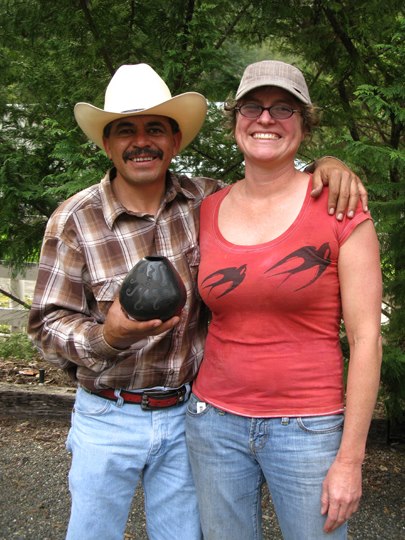
Jerardo & Me with my fired pot
   I spent this last week in a class with Mata Ortiz master potter, Jerardo Tena Sandoval.  The tarry lump of black clay I received, directly from the Mata Ortiz hills, was fundamentally different from the product I pull from bags at home. It was sticky and thick with a stubborn tenacity that enables it to be formed into incredibly thin walls in any direction.  The available clays there range in colors from blue to yellow, white, red and beige, most of which fire to a brown color in oxidation but all can be turned black in reduction.  One of my favorite effects from Mata Ortiz is their black on black, especially those with the metallic mirror quality.  Apparently, however, that effect requires a lot of powdered graphite combined with diesel fuel, so we did not experiment with it in Healdsburg.  We did have some dark blue-black clay whose blueness only ghostly remained in the reduction firing.
Jerardo Tena Sandoval
     We began by flattening the ball into a tortilla and pressing it into the curved plaster form for the bottom.  Using a rib made from credit cards cut into circles, or Jerardo’s favorite tool, a plastic toy tea saucer, we pressed the clay into the base and began pinching up the sides.  We added a “chorizo” of clay to the lip to make it taller, continuing to pinch and push.  The most effective tool for me was the hacksaw blade that we used tooth-side first to unify the wall by pulling clay into depressions and eliminating high points.  Unlike normal throwing techniques of plenty of water, we had to keep our hands clean and dry to prevent marring the surface with dried clay. Then, lightly dampened, we ran the back/smooth side of the blade across the surface to further smooth it.  This clay, while strong enough to reach maturity in a brief but hot 30-minute firing, is extremely sensitive to moisture.  It dries slowly and is quick to crack if the moisture is uneven.  Sadly Jerardo recalled how, after three months of painting, a humid wind caused a crack in the wall of a large pot with jaguars on the lip.
Painting in Joann's studio. Hating it ans
convincing myself to stay
     For two days, we left the pots to dry then returned to sand them.  “This is what it sounds like in the village,” Joann commented as we all settled in with our 100-grit paper.  Dried, the clay is like cement, requiring vigorous, lengthy, arm-straining work to smooth the surface.  The more you sand, the more you can see the tiny divots as they filled with contrasting clay dust and demanded more sanding.  Once finished with that, you move on to 200-grit paper and finally, 300-grit, until you have “baby-butt” smooth pots.  Being of an impatient nature, I quickly tired of this and again increased my respect for the perfect surfaces of the Mata Ortiz pots.
     To burnish, we rubbed baby oil all over the pot and waited for it to dry.  Then we rubbed a small section with a damp cloth and rubbed it with a tumbled stone.  This turned the surface bright and reflective.  Finally we were ready for the decorative step and made paintbrushes from Jerardo’s daughter’s hair.  The paintbrush for the fine line work consists of only 8 hairs and is almost 2 inches from the tip of the brush to the tip of the wood.  Jerardo loads the brush with paint, lays it on the surface of the pot and slowly drags it.  In demonstration, he painted a grid where the gaps between the lines were only the thickness of the paintbrush.  It made me cross-eyed just watching him.
     I attempted painting in the Mata Ortiz style, naturally choosing to depict an octopus as goes my fixation.  Unfortunately, the precision paintbrushes are more inclined toward straight lines than curly ones.  “What do you do if you mess up?” asked one of my fellow students.  “Change the design!” smirked Jerardo. I became so frustrated I had to talk myself out of leaving.  I made a mess of my pot.  Finally I asked Joann if she had a needle tool so I could revert to my accustomed technique.  She handed me an inscriber, designed for etching into metal, and I was in heaven.  I was able to make curved lines, correct the edges of my paint job and, feeling joyous once again, dared to erase my stilted lines with the dampened rag and re-burnish.  My pot was cracked already anyway.
Oxidation firing completed
Reduction Firing completed
     The next day we brought our pots to be fired to another potter’s home in Forestville.  Since it had rained, we had to construct an additional fire to dry the area and heat the ground.   Meanwhile we preheated the pots in the oven.  Apparently this is done in Mata Ortiz by holding the pots over a fire, but since we had an oven, we used it, bringing the pots slowly up to 450 degrees.  When the first fire died down, we pulled the coals away and placed three bricks under a metal drum cut to 1/3 height.  Inside the drum, a BBQ grill, held from the bottom with a few kiln bricks, supported the heated pots retrieved from the oven wrapped in towels and quickly transferred.  A loose metal lid kept oxygen flowing through the drum but prevented the smoke from turning the pots black (oxidation firing).  We piled kindling around the drum and on top, doused it with lighter fluid and let it burn for ½ hour.  For the subsequent reduction firing, the drum was inverted and sealed over the pots and a bed of sawdust both to burn out the oxygen and provide more smoke.  In this firing, the painted areas, originally white for greatest contrast, turned matt black and the unpainted, burnished areas turned a deep glossy black.
     I was honored when Jerardo, the master potter, complimented my pot, and I was proud to be in the company of fellow artisans.  In Mata Ortiz, a town made famous by the revival of ancient pottery techniques using the most locally available resources, a potter is only granted the name of “Master” if he or she can perform every step of the process from harvesting the clay and paint ingredients from the surrounding hills, processing them, forming pots, making paintbrushes, burnishing, painting, and firing them.  In Peace Corps, I had notions of creating such an industry in my own site where clay was plentiful. In studying Mata Ortiz and the years of experimentation it has taken them to arrive where they are today, I realize finally that it was not my lack of ambition that prevented it from occurring, but a sense of scale.  It took Juan Quezada and fellow potters around 20 years to develop what they are still perfecting today.  They just celebrated the 50 year anniversary of the first perfectly fired pot of this revival movement.  I have found my respectful place in this historical context.  I can stand proud next to this master potter, as a skilled potter myself, and part of a global community of mud-slingers. After all, this incredible art form that has developed simultaneously in most parts of the world in limitless variability is evidence of human ingenuity and our innate drive toward creativity.
 
Panther-lipped pot Jerardo worked on in class

Jerardo's effigy

Jerardo's ram

Mata Ortiz Contact info:
     MataOrtizCalendar.com or Mata Ortiz Calendar on FB.
     If you’re interested in buying any of Jerardo’s pottery you can contact him at Jerardo Tena Sandoval via FB.
     If you are interested in having classes with Jerardo in the Bay Area, call Joann Cassady at 707 431-8319, email: joann@imakepots.com or Joann Cassady via FB.